Used for spoken replies from the assistant and on
the Voice board. Voices come from your browser, so the list depends on your
device. Recorded clips keep their own voice.
MSc Artificial IntelligenceQueen’s University Belfast, due 2027
First-Class BSc (Hons)Computer Science, The Open University
Inside the system
From night flows to a weekly plan.
Follow a week of network data from raw flows to where detection crews go next.
Step 1 of 3
Weekly inputs
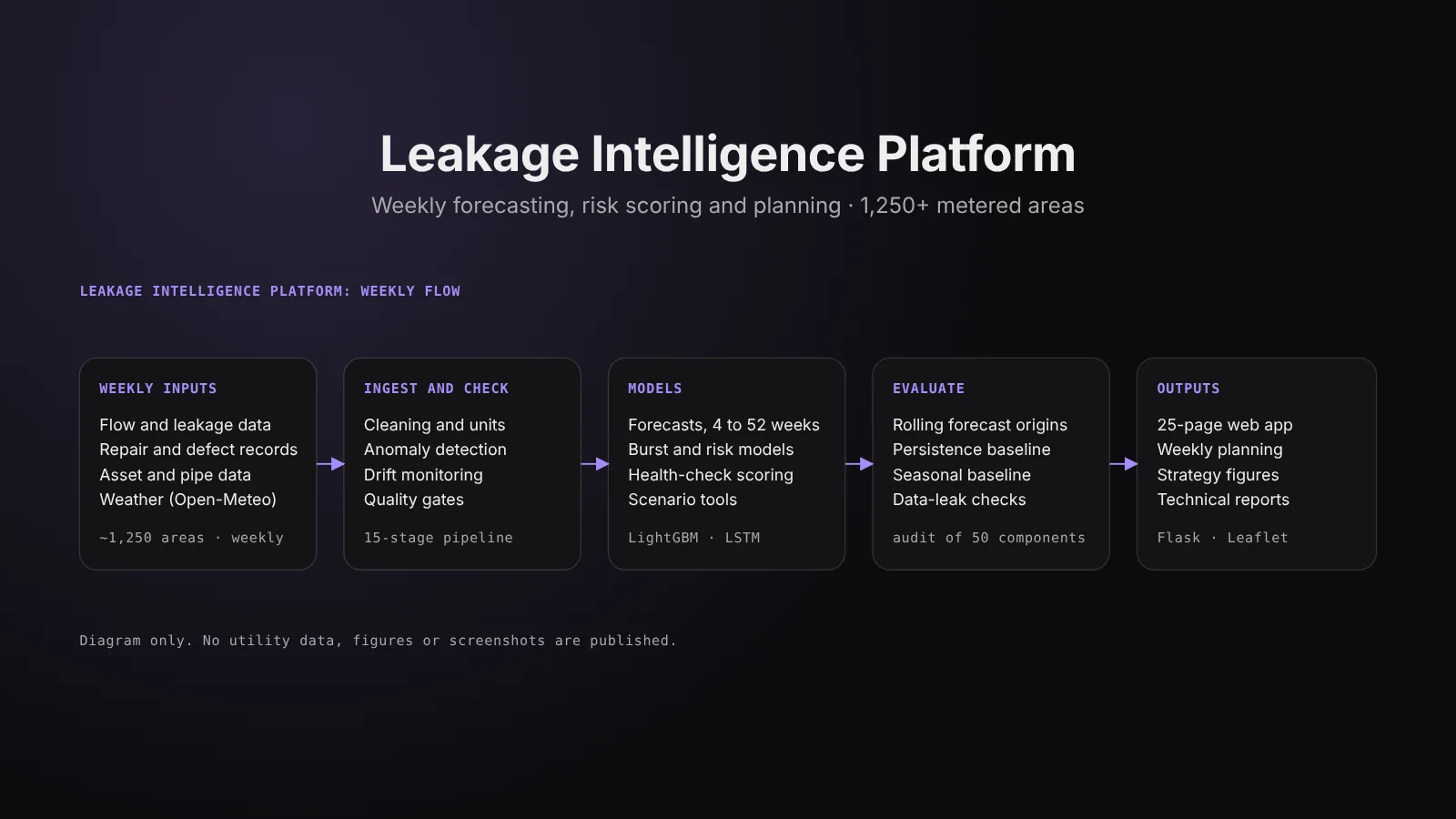
Night-time flows for more than 1,250 metered areas arrive each week with repair, asset and weather data. The data is noisy, irregular and incomplete, so it is cleaned and checked for anomalies before anything is modelled.
Step 2 of 3
Forecast & score
Models forecast leakage 4 to 52 weeks ahead, estimate burst risk and score every area's health. Each model is tested at rolling forecast origins against simple baselines before it is trusted.
Step 3 of 3
Weekly plan
A 25-page web application turns the results into maps, priorities and a schedule for detection teams. The utility's data is not published; the case study describes the system and my role.
Follow a care record from source tables to an operational dashboard.
Step 1 of 3
Source records
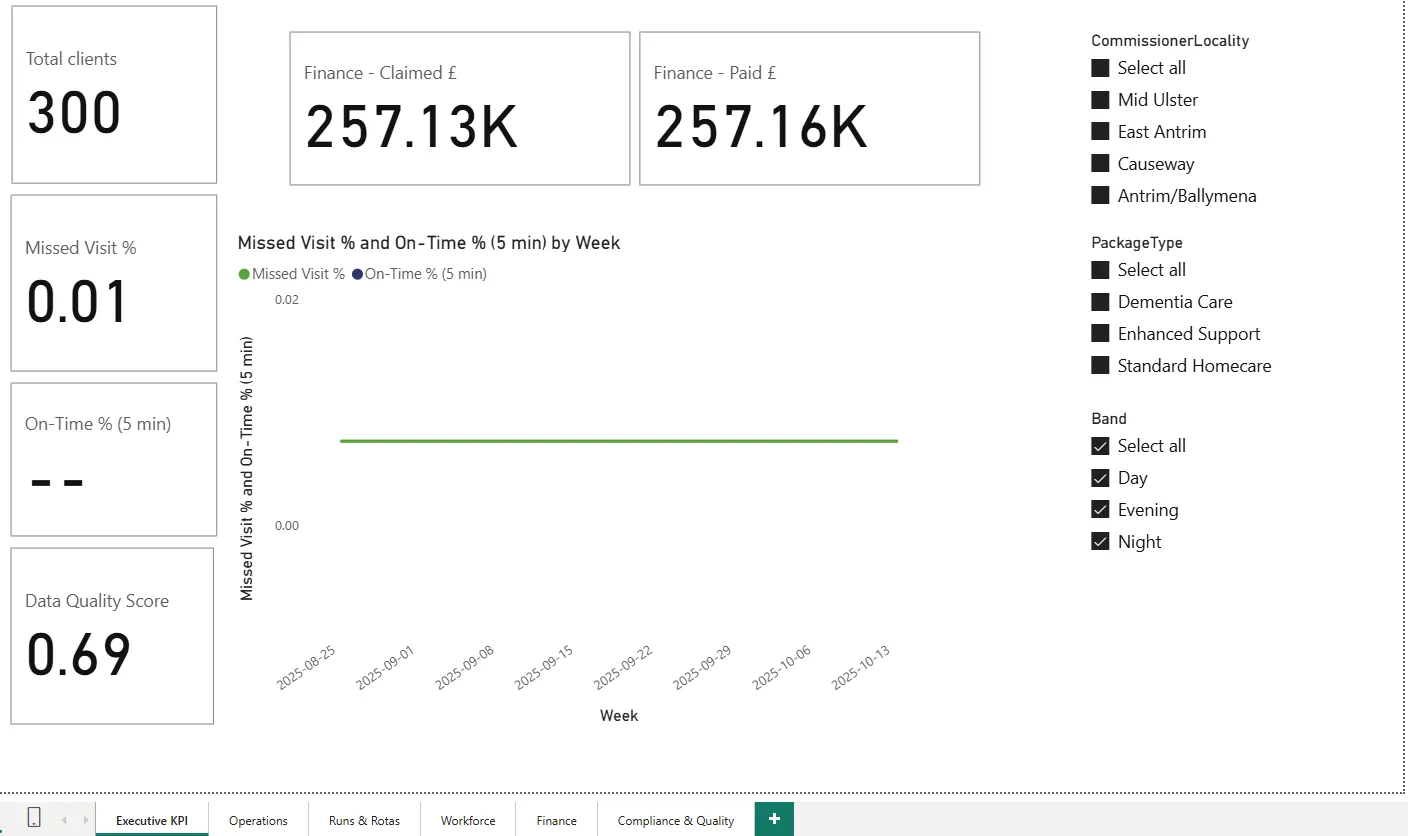
Client records, visits, runs and rotas, workforce and finance data form the source layer. Aurora uses a synthetic dataset to demonstrate a Northern Ireland care model.
Step 2 of 3
Transform & model
Power Query cleans and prepares the tables. The data model connects them, while DAX measures turn visit and finance records into reportable indicators.
Step 3 of 3
Operational insight
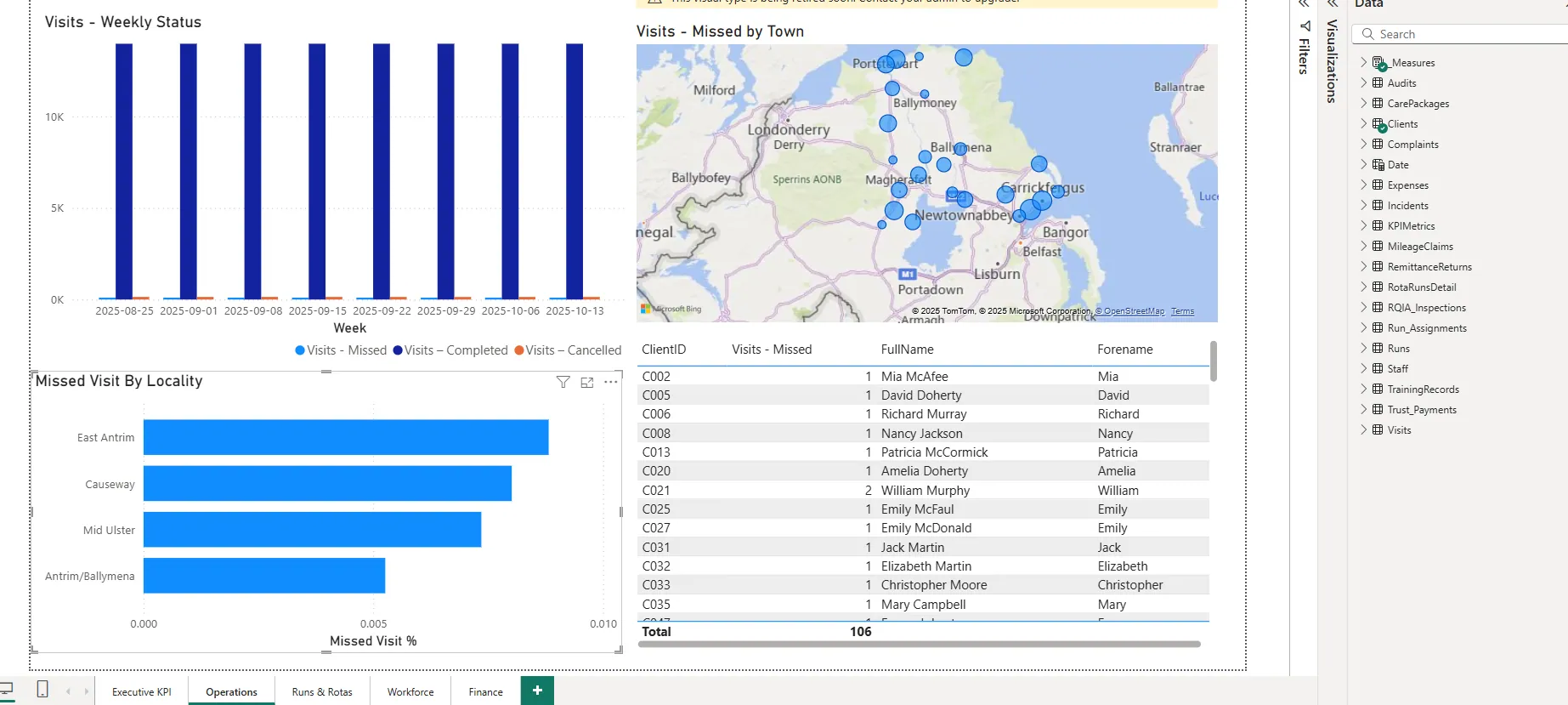
Dashboards bring together missed visits, workforce, finance and compliance, with locality views and mobile layouts.
A water utility needs to know each week where leakage is rising and where detection crews will do most good.
My contribution
Built the weekly pipeline, forecasting and risk models and web application, then audited the models' validation and rebuilt it against simple baselines.
A home-care coordinator needs to notice who is getting worse before it becomes an emergency.
My contribution
Built live NEWS2 monitoring, an explainable 30-day admission-risk model with a model card, and a plain-English assistant that answers from the records.
Each answer below is a measured result from two studies on public data, with the method, the failures and the corrections published beside it.
Is the result real?
0.14 R² from noise
Choosing a model's inputs before testing it scored 0.14 on shuffled data with nothing to find. That is as high as the real result. Done in the right order, the same recipe scored below zero.
Three and seven days ahead, 75 to 80% of the model's high-river warnings were wrong. A band drawn around today's flow, with no model at all, came close: 0.155 against 0.175 on the same score at seven days.
A forecasting model trained on wet catchments and tested on dry ones lost about 0.10 of its skill, against 0.03 for a control trained on a random half. A whole region held out of training cost 0.019.
Refit the same model on a slightly different sample and its list of the 20 most important inputs changes. On average two refits share about a third of their lists (an overlap score of 0.20). Only two inputs stayed near the top.
One to two minutes each, filmed from this site: the Voice app, both studies, the method behind them, and the demos. Every fact in them can be checked on the page each one links to.
Voice: an AAC app that explains its predictions
How a communication app suggests the next word, offline, and says why 1:37
Transcript
This is Voice, an AAC app built by Paul McNeill. AAC stands for augmentative and alternative communication: a way to talk for people who cannot rely on speech.
The user builds a message by tapping words on a board of colour-coded tiles. Every word keeps the same place, in Child and Adult modes alike, so the board can be learned by position instead of searched.
As the message grows, Voice suggests the next word. Each suggestion says why it was offered, for example a common next word, or a word you often say next.
The prediction runs entirely on the device, with no network calls. It is a trigram model built from 666 sentences written for Voice, with an optional personal layer and a small ranker on top. Each set of suggestions takes well under a millisecond on a desktop computer.
Learning is off by default. When it is switched on, Voice learns only from messages that are actually spoken, never from taps that are deleted. Here, after I want Grandma has been spoken three times, Grandma appears as a suggestion, marked as a word you often say next. Everything learned can be seen, and forgotten, one word at a time.
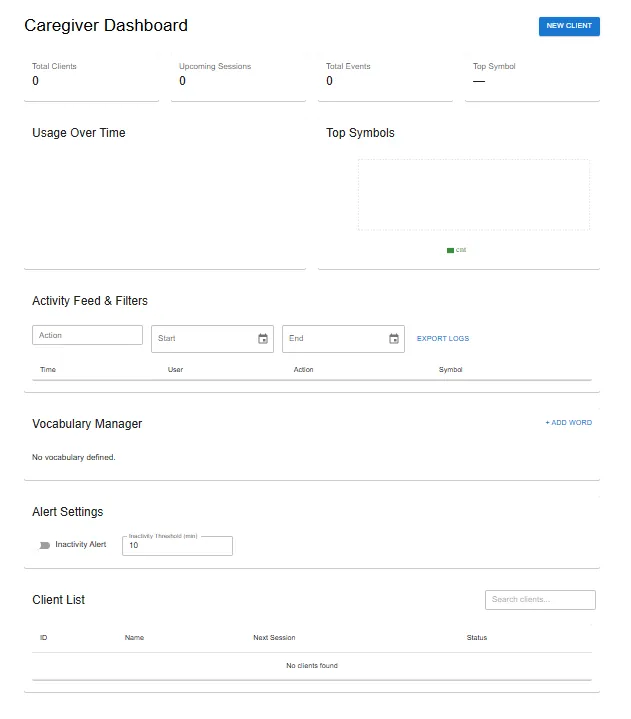
A caregiver dashboard sits alongside the app. You can try the board, the full app and the dashboard, all with made-up data, on Paul's portfolio at paulmartinmcneill.com.
A test across 671 British catchments, and where the skill really comes from 1:52
Transcript
Can river floods be forecast without knowing tomorrow's weather? Paul McNeill tested that across 671 British catchments, using CAMELS-GB, a public dataset of daily river flow and weather from 1970 to 2022.
The task: on any given day, forecast river flow one, three and seven days ahead, using only what is known that day. The models were trained on 1970 to 2004, tuned on 2004 to 2012, and tested on 2012 to 2022.
Skill is measured with a score where 1 is a perfect forecast and 0 is no better than the long-term average. Most of the skill beyond a day depends on knowing the weather. At seven days, the median score is 0.24 without future weather, and 0.72 when the model is given the weather that actually happened. That second number is an upper bound, not a forecast.
Forecasting a whole region the model never saw costs little: a median loss of 0.019 at one day. A different climate costs much more. Trained on wet catchments and tested on dry ones, the score falls from 0.85 to 0.75.
A neural network, an LSTM reading a year of daily data, did no better than gradient boosting. That points to the missing weather forecast as the limit, not the choice of model.
Warnings are harder still. At seven days, most high-flow warnings are false alarms. The study has not been peer reviewed, and every decision, including the mistakes, is logged in public.
924 cell lines, one known marker, and a common mistake measured 1:39
Transcript
One gene, PTEN, is a known but incomplete guide to how cancer cells respond to drugs that block a protein called AKT. This study asks how much more wider molecular data can explain, using 924 cancer cell lines from the public GDSC screen.
PTEN alone explains about 5 per cent of the variation in response. Adding cancer type and sequencing centre takes that to 11 per cent. Adding two thousand genes reaches 14 per cent with an elastic net, and 19 per cent with gradient boosting.
So more than four fifths of the response stays unexplained. And that gap is not mainly measurement noise. A related drug was measured twice: about 80 per cent of its variation repeats, yet the best model for it explains only 18 per cent.
The study also measures a common mistake. Choosing genes by their link to the response before cross-validating produces a score of 0.14 even on shuffled data, where there is nothing to find. Choosing inside each fold removes the leak.
The explanations were not stable either. The top twenty genes of refitted models overlap by only 0.2, and no stable subgroups were found beyond tissue of origin.
Cell lines are a stand-in: nothing here is about patients or treatment. The study has not been peer reviewed. The code, protocol and decision log are public.
How two reproducible studies were run, and the mistakes they caught 1:32
Transcript
Two studies, one set of rules. This is how Paul McNeill runs machine learning research that someone else can check.
Protocol first: the design is written and dated before any model is fitted, and any later change is a dated amendment.
Baselines first: every model is compared with the simplest thing that could work, on exactly the same held-out data. The data splits are saved once with a fingerprint, and the code refuses to overwrite them.
Nothing is learned from held-out data: feature choice, scaling, gap filling and tuning all happen inside the training data. What counts as this did not work is set in advance, and negative results are reported.
And every decision is logged, including the mistakes. In the river study, the first diagnosis of a weak baseline was wrong; a controlled comparison showed the cause was the target scale. In the drug study, gains were first computed on averaged predictions, which flattered the less stable model. Both were corrected in public.
Both studies were built making use of AI tools, under research rules Paul set, and each study's log records how. Re-run on a second machine, the main results matched almost exactly; one river experiment is still to be repeated. Neither study has been peer reviewed.
Narration, a voice assistant and a voice picker on paulmartinmcneill.com 1:16
Transcript
Paul McNeill's portfolio is built to be heard as well as read. The main pages have a short recorded narration, with the full transcript one tap away.
The narration uses an AI voice made with ElevenLabs, and every player says so. It is not Paul's voice.
The site's text assistant can be used by voice too. Press the microphone and speak; the question appears as you talk, and the reply can be read aloud.
Visitors can choose that voice, the same way they choose the colour and the font. The picker lists the voices on their own device, with a speed control and a preview, and the choice is remembered in their browser.
On the Lab page there is also a live voice assistant. It answers questions about Paul's work from a fact sheet taken from the site, and says it is not Paul. Nothing from ElevenLabs loads until the visitor presses the button.
All of it is plain HTML, CSS and JavaScript on a static site. Speech recognition and the voice picker use speech features built into the visitor's browser, and the site still works with no sound at all.
A sentiment model, a word predictor, a voice assistant and an agent animation 1:08
Transcript
The Lab on Paul McNeill's portfolio holds four working demos. Three of them run entirely on the visitor's device.
First, a sentiment model. It is a small public example model from TensorFlow.js, trained on movie reviews. Type a sentence and it scores how positive it is, inside the visitor's browser, with nothing they type sent to a server.
Second, the word board from Voice, Paul's AAC app. It runs the app's real prediction engine, so the suggestions and their reasons match the app.
Third, a live voice assistant built with ElevenLabs. This is the one demo that uses a server: what the visitor says is sent to ElevenLabs, and the page explains that before anything loads.
Fourth, an animation of how a research agent works through a task: input, planning, tool use, memory, synthesis and output. It is an illustration of the pattern, not a live agent.
I’m Paul, an AI engineer, web developer and data analyst based on the island of Ireland.
I build machine learning forecasting tools, web platforms and analytics
for water infrastructure, healthcare, accessibility and day-to-day operations.
My current work is a leakage forecasting and planning platform for a UK water utility,
covering more than 1,250 district metered areas. Alongside it I run
reproducible research on public data, and earlier work includes
an AI-enhanced care-management app built on synthetic data and AI accessibility tools such as a predictive AAC app for non-verbal users.
I’m studying for an MSc in Artificial Intelligence at Queen’s University Belfast (due 2027)
and hold a First-Class BSc (Hons) in Computer Science from The Open University.
I’ve also completed the Open University’s postgraduate M816 Data Management module.
Paul took our domiciliary care reporting from scattered Excel files and manual processes to a fully automated Power BI suite. What used to take the team days now takes minutes. He understood the clinical context, not just the data — that's rare.
Dr. Claire HendronService Manager, Domiciliary CareNorthern Health & Social Care Trust
We needed someone who could handle the full picture — data modelling, ETL pipelines, DAX, and the front-end dashboards — and explain it all to non-technical stakeholders. Paul delivered on every front.
Gareth MurrayHead of Digital ServicesNHSCT
The AAC app Paul built changed how we think about assistive technology. The AI prediction engine was fast, accurate, and most importantly, the families found it intuitive. That last part is the hardest to get right.
Dr. Aisling O'KaneSpeech & Language TherapistHSC Northern Ireland
Get in touch
Have something worth building?
Currently open to AI engineering, ML, and full-stack web opportunities — full-time, contract, or freelance.
Tell me about the role or project, what you need built and your timeline.
Answers from my portfolio using Cloudflare AI. Usage limits apply.
Messages aren’t saved by this site. Privacy.
The microphone uses your browser’s own speech recognition, which may send
audio to the browser’s maker (Google in Chrome, Microsoft in Edge, Apple
in Safari). For a spoken conversation, try the
voice assistant.